Let patterned curtains carry a room without multiplying the motif
Large curtains can make a pattern much more prominent than it appeared in a small fabric sample. Treat the window area as a substantial field, then choose what the rest of the room should repeat. The goal is a room that enjoys the pattern without automatically copying it everywhere.
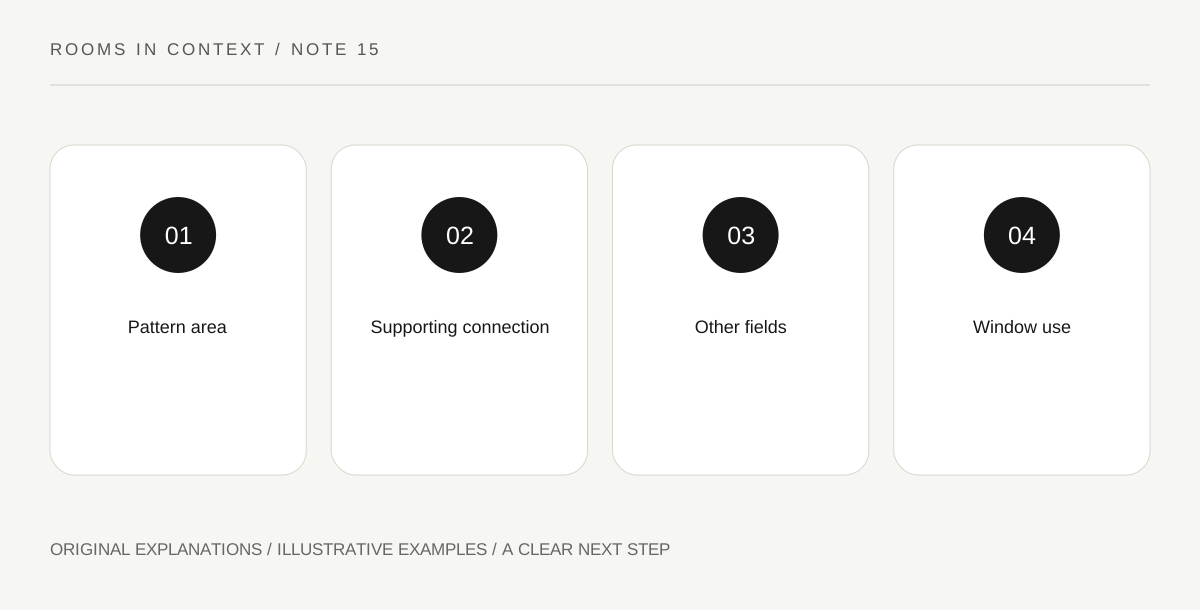
Original explanatory diagram. Read the full method and limitations below.
Estimate the visible pattern area
Look at the window width, curtain fullness and the amount of fabric visible when open or closed. A small sample shows a motif but not the full repeated field. Sketch the curtains in both positions. The pattern may lead only at night when closed, or remain a strong frame during the day. This changing state matters when deciding how much additional pattern the room should contain. Compare both states before choosing another patterned surface.
Choose one supporting color or shape
Select a broad color from the fabric or a simple shape relationship you want to echo elsewhere. A plain cushion can connect to one color without repeating the whole motif. Alternatively, a curved object may relate to a curving pattern. You do not need exact matching fabric for every accessory. The useful connection should remain legible at room scale rather than depend on a tiny thread color that only appears when examined closely.
Compare the other major patterned surfaces
An existing rug, tiled floor or upholstered chair may already provide a second strong pattern. View them together with the curtain sample or mock-up. Decide which should lead and whether differences in scale or contrast produce a relationship you enjoy. A busy room can be deliberate, but the decision is clearer when you see the main fields together instead of approving each attractive pattern separately in a shop.
Keep window function part of the design
Light control, privacy, opening access and appropriate installation remain separate practical requirements. Do not infer blackout, insulation or other performance from visual weight alone. Read actual product information and obtain suitable installation guidance. The room study can begin with a large paper or fabric mock-up while those details are checked. Record the curtain’s open and closed roles, the supporting connection and which other patterned field remains intentionally different.
Illustrative worked example
Illustrative room: A curtain fabric has large blue leaves on a pale ground. The reader sketches it open and closed, then chooses a plain muted-blue cushion rather than matching leaf cushions. An existing small geometric rug remains, but several patterned accessories are removed after comparison. The room keeps two different pattern fields with clear roles: curtains as the large organic feature and rug as a quieter lower texture.
Questions that come up
Must every pattern share an identical color?
No. A common color can help, but scale, contrast and placement also matter. Choose the actual relationship you enjoy in the room.
Does a heavy-looking curtain guarantee blackout?
No. Appearance is not a performance specification. Use the product’s actual information and appropriate fitting details for light-control decisions.
References and scope
These sources support the factual background. Examples and exercises are original illustrative teaching material. References do not imply endorsement.
- V&A Furniture collection — Primary reference objects for studying furniture forms, construction and material relationships.
- V&A Arts and Crafts introduction — Historical context for material, making and pattern in Arts and Crafts.