Build a country-style room around artwork rather than novelty objects
A country-inspired room can begin with a landscape, print or family artwork instead of collecting decorative farm motifs. Use the image’s palette, framing and sense of space as the reference. This creates a specific room study rather than a checklist of rustic-looking purchases.
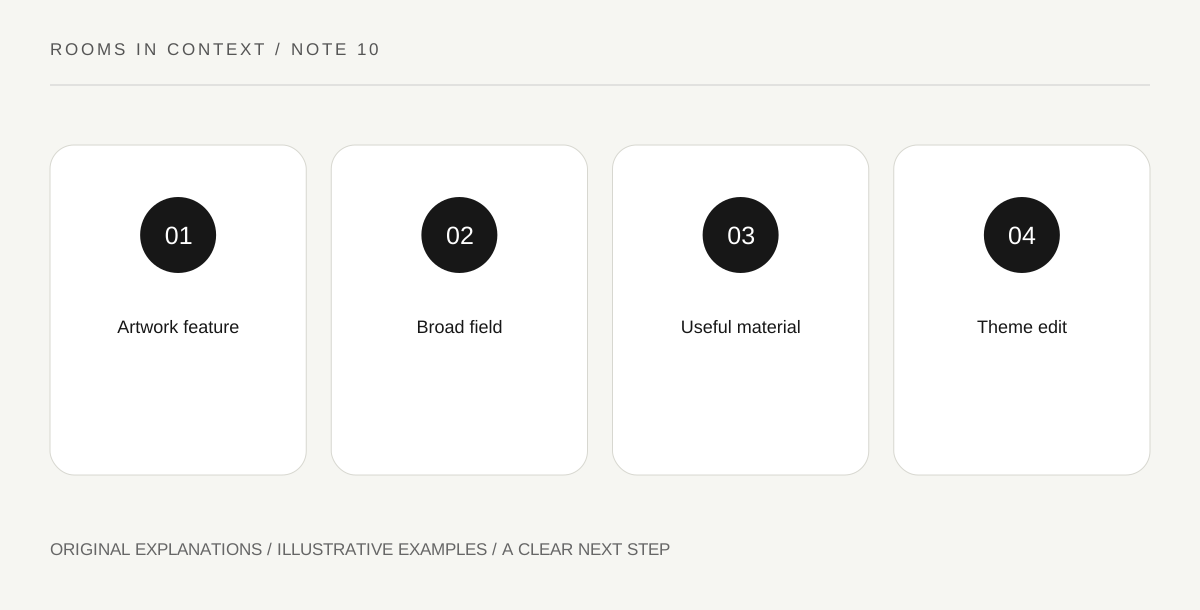
Original explanatory diagram. Read the full method and limitations below.
Read the artwork as a source of relationships
Identify a few visible qualities: a broad pale sky, a dark line of trees, warm earth or a repeated curve. You do not need to extract every color from the image. Choose the part that interests you most and describe it in ordinary words. If the artwork has a personal story, that can matter too, but do not invent a provenance or artist attribution from its appearance. Keep the image visible during the comparison.
Choose a broad field from one part
A textile or existing upholstered piece can echo the image’s larger color area. For example, a quiet pale field may relate to the sky without matching it exactly. Compare the actual object beside the artwork under the room’s light. The relationship should make sense at normal distance. Repeating a tiny detail in several accessories can create more busy reference points than the larger image itself needs.
Use material to support the chosen mood
A visible wood form, woven surface or simple ceramic can provide texture. Select objects with useful roles rather than adding them solely because they look country. A worn appearance is not proof of age, quality or craftsmanship. You can enjoy a material’s character without artificially damaging it or assigning a history it does not have. Let the artwork remain the specific reference that connects the surrounding objects.
Keep the room from becoming a theme inventory
Review the composition with novelty signs, decorative animals or other motif-heavy objects removed, if those are present. Add back only the ones you actually enjoy. Country-inspired can be a quiet relation between image, wood and textile rather than a literal display of a rural stereotype. Check practical placement and appropriate mounting separately. The final note should identify the artwork’s role and the few surrounding decisions it genuinely influenced.
Illustrative worked example
Illustrative sitting room: A landscape print has a pale sky, dark tree line and muted ochre ground. The reader uses an existing pale curtain as the broad field, repeats ochre in one cushion and keeps a simple wood table. She removes a cluster of novelty signs because they compete with the image. The room’s country reference now comes from a specific artwork and material relationship rather than many unrelated rural motifs.
Questions that come up
Does country style require distressed furniture?
No. Material, pattern and a specific reference can create the mood without artificial damage or an aged finish.
Must the artwork show a landscape?
No. A botanical print, textile or other meaningful image can guide the room. The method depends on clear relationships rather than one mandatory subject.
References and scope
These sources support the factual background. Examples and exercises are original illustrative teaching material. References do not imply endorsement.
- V&A Furniture collection — Primary reference objects for studying furniture forms, construction and material relationships.
- V&A Arts and Crafts introduction — Historical context for material, making and pattern in Arts and Crafts.