Keep a dark bookcase in a light contemporary room
A dark bookcase can serve as a strong rectangular field within a lighter room. Rather than hiding every book or painting the unit immediately, study its outline, contents and relationship to nearby furniture. This is a composition exercise, distinct from reorganizing a library for retrieval.
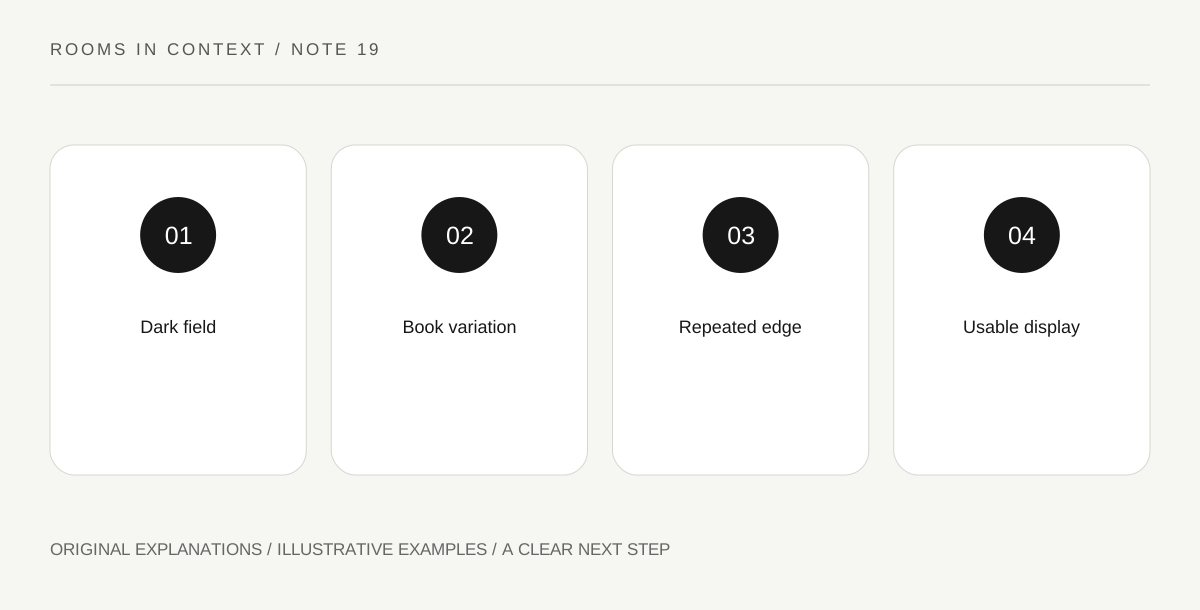
Original explanatory diagram. Read the full method and limitations below.
Observe the whole dark field
Look at the bookcase from the room entrance, including shelves, side panels and the objects inside. A backless frame creates a different visual mass from a solid cabinet. Describe how much dark surface remains visible once books are present. The room’s light furniture may contrast with the case, but the contents can break that dark field into many smaller areas. Begin with the actual occupied unit rather than an empty product image.
Choose how much variation to retain
Books naturally introduce colors, heights and spine patterns. Decide whether you enjoy that variety or want a quieter presentation using the collection’s existing groupings. Do not sacrifice access to useful books merely to create a color arrangement that nobody can maintain. The style decision can concern a few visible open areas or object groups while the library’s practical organization remains understandable to the people who use it.
Connect the case to another dark edge
A picture frame, chair base or lamp can repeat a dark line if you want the bookcase to feel related to the lighter furniture. One connection may be enough. Compare the room before adding several new dark objects. The bookcase can remain the main anchor rather than starting a requirement that every surface needs a matching black detail. Describe the line and placement of the repeat, not just the color name.
Assess display without overloading the shelves
Use the furniture within its appropriate capacity and installation requirements. Decorative objects should not create unstable stacks or interfere with book access. Review the case with the books you actually need, including the volumes that are temporarily elsewhere. The final note identifies the dark field, the retained variation and the connection to the rest of the room. This lets the bookcase contribute to a contemporary composition without pretending that a lived library is an empty architectural grid.
Illustrative worked example
Illustrative room: A dark solid bookcase sits opposite a pale sofa. The reader keeps the collection’s useful subject groups, leaves one suitable open shelf area and adds a simple pale object there. A dark chair base repeats the case’s outline elsewhere. She rejects arranging every spine by color because it would make the household’s reference books harder to find. The case remains a strong field with purposeful visible variation.
Questions that come up
Must contemporary style hide all colorful books?
No. Color variation can remain part of the room. A contemporary composition can come from clear surrounding forms and chosen relationships rather than an empty shelf.
Should I paint the case before planning the room?
Not automatically. Study its existing role first. Any finish change depends on the actual material, condition and appropriate treatment information.
References and scope
These sources support the factual background. Examples and exercises are original illustrative teaching material. References do not imply endorsement.
- V&A Furniture collection — Primary reference objects for studying furniture forms, construction and material relationships.
- V&A The sophisticated Modern home — Context for modern domestic objects and their functional and visual relationships.