Make two different sofas look intentionally related
Two sofas can differ in color, arm shape or age and still form a coherent room. The useful question is which relationship connects them and which differences you want to preserve. Begin with the actual pair rather than assuming a matching suite is the only finished result.
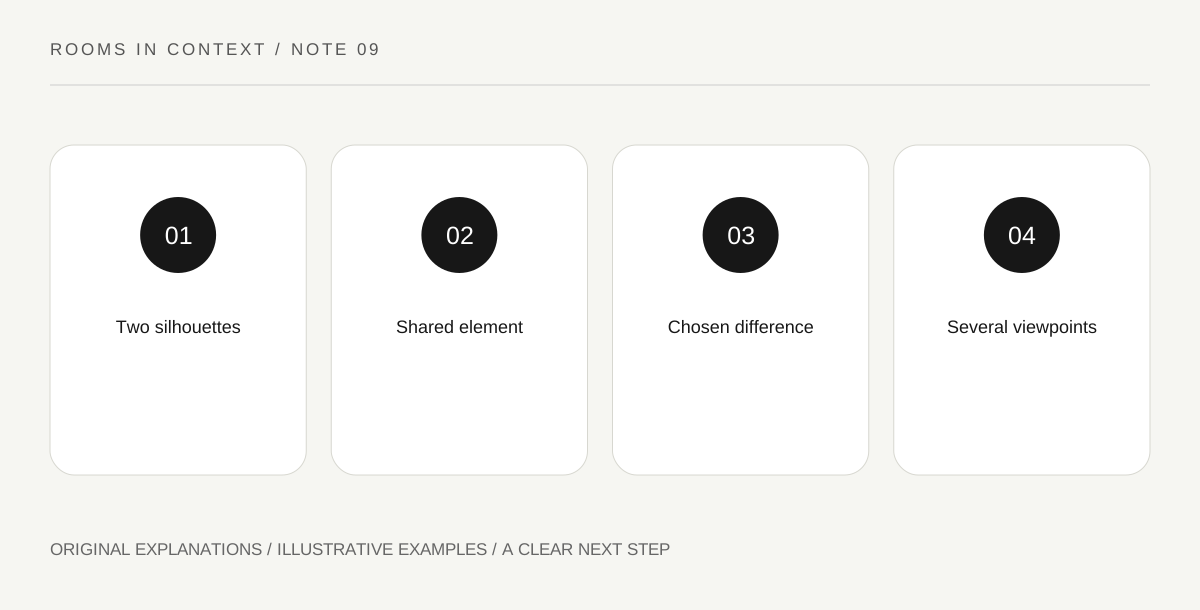
Original explanatory diagram. Read the full method and limitations below.
Describe the two silhouettes separately
Look at arm height, back shape, visible legs and cushion rhythm. A low boxy sofa and a taller rounded one introduce different lines. Write those differences plainly before adding textiles. This helps you see whether the strongest contrast comes from shape, surface or color. A room can become confusing when several attempts to match the colors distract from a much larger difference in the furniture’s outline.
Choose one shared element
A repeated textile color, similar leg finish or a common relationship to a rug can create a connection. You do not need to make every feature match. Start with one existing item and compare the pair before and after introducing it. A shared element should remain visible at the room’s normal scale. Tiny cushion piping may be less effective for this purpose than a broad color that appears clearly on both sides.
Keep the differences as part of the composition
If one sofa is visually heavier, decide whether it should anchor the room while the lighter one plays a supporting role. Equal importance is not compulsory. Look from the entrance and from both seats, because the room has more than one useful viewpoint. Avoid arranging the furniture solely for a front-facing photograph if that compromises conversation, access or the way people actually use the room.
Use textiles without disguising every surface
A throw can introduce a connection, but a covering arrangement that constantly slips or hides an object you enjoy may not be useful. Follow the furnishings' care information and choose manageable items. Include ordinary cushions, reading materials and other daily contents when reviewing the result. Record the shared element and the chosen asymmetry. That explanation can make an eclectic pair feel deliberate without inventing a rule that every room needs two contrasting sofas.
Illustrative worked example
Illustrative room: One sofa is dark green and low, while the other is pale and rounded. The reader repeats a muted blue in one substantial cushion on each, then removes several smaller patterned cushions that distract from the sofa shapes. She lets the green sofa anchor the room and checks the view from both seats. The pair remains visibly different, connected by one readable color rather than forced into an imitation matching set.
Questions that come up
Must the sofas be the same size?
No. Different sizes can work if the layout and use are comfortable. Their relationship should be assessed in the actual room rather than from a symmetry rule.
Can cushions fix every mismatch?
No. Cushions are one compositional tool. If scale, access or comfort is unsuitable, decorative repetition may not resolve the underlying furniture problem.
References and scope
These sources support the factual background. Examples and exercises are original illustrative teaching material. References do not imply endorsement.
- V&A Furniture collection — Primary reference objects for studying furniture forms, construction and material relationships.