Soften the visual reading of an existing concrete floor
An existing concrete floor can support a room with warmer, quieter companions while remaining visibly concrete. The useful distinction is between changing the visual relationship and claiming a technical change in comfort or performance. This study begins with movable materials and the room’s actual use.
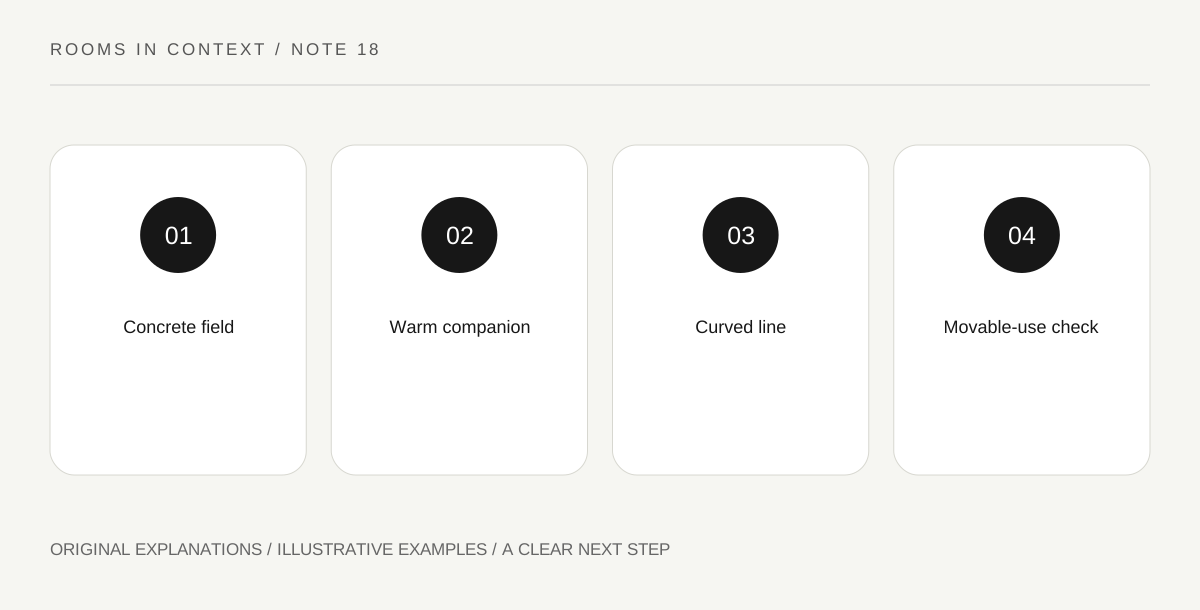
Original explanatory diagram. Read the full method and limitations below.
Read the floor as a broad surface
Observe color variation, joints, visible texture and reflected light. A smooth gray field differs from a strongly mottled one. Name the feature that draws your attention first. Do not assume the floor has a particular finish, slip behavior or maintenance method from appearance alone. For the composition study, an accurate visual description is enough; technical care and any treatment require information about the actual installed surface.
Choose one warmer-looking companion
A timber table, warm-colored textile or substantial upholstered piece can create a contrast beside the floor. Compare actual samples and objects rather than using a generic warm palette label. One broad soft field may change the room’s reading more clearly than many tiny accessories. This is a visual decision, not proof that the room’s temperature or measured acoustics have changed. Keep those performance questions separate if they matter to the household.
Balance hard edges with selected curves
A rounded chair or curved object can introduce another line alongside the floor’s joints and rectilinear architecture. You do not need to make every piece curved. Compare one clear contrast with a room full of repeated rounded forms. The floor can remain a strong quiet base while furniture supplies the variation. Choose useful objects at an appropriate scale rather than buying shapes that serve no practical role.
Check the movable layer in ordinary use
If a rug or textile enters the scheme, evaluate appropriate stability, placement, care and compatibility with the surface. Keep doors and walking routes usable. Do not apply coatings or adhesives simply to test a visual idea. Begin with samples and suitable freestanding objects, then review the room in daylight and evening light. Record which material area and line changed the impression, leaving the concrete’s real technical properties to the appropriate product or professional information.
Illustrative worked example
Illustrative lounge: A gray concrete floor remains exposed around an existing sofa. The reader introduces a substantial warm-toned textile and a curved timber chair. She compares several small rustic accessories but removes them because they do not add a clear relationship. A suitable rug is considered for its actual placement and use, not as a guaranteed acoustic treatment. The final scheme leaves concrete visible while giving wood and upholstery distinct roles.
Questions that come up
Must concrete rooms look industrial?
No. Existing materials can sit within different compositions. Furniture, textiles and line relationships can change the reading without disguising the floor.
Will a soft-looking rug guarantee sound reduction?
No. Technical performance depends on the actual product and room. Use suitable specifications or professional guidance when a measurable acoustic outcome is required.
References and scope
These sources support the factual background. Examples and exercises are original illustrative teaching material. References do not imply endorsement.
- V&A Furniture collection — Primary reference objects for studying furniture forms, construction and material relationships.
- V&A The sophisticated Modern home — Context for modern domestic objects and their functional and visual relationships.